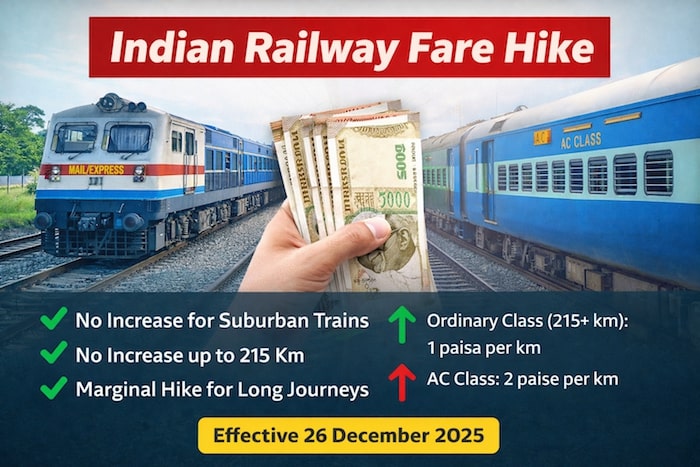
The Indian Railway Fare hike has officially been announced, with the new fare structure coming into effect from 26 December 2025. While the term “fare hike” may worry passengers, the Indian Railways has adopted a balanced and minimal increase approach, ensuring affordability for short-distance and suburban travellers.
In this article, we break down who will pay more, who won’t, and how much extra passengers will actually spend under the revised fare rationalisation.
Table of contents
- 1 Overview of the Indian Railway Fare Hike 2025
- 2 Distance-Wise Fare Changes Explained
- 3 No Fare Hike for These Passengers 🚆
- 4 Why Indian Railways Increased Fares in 2025
- 5 Improved Safety & Operational Efficiency
- 6 Passenger Impact: Is the Fare Hike Significant?
- 7 FAQs on Indian Railway Fare Hike
- 8 Conclusion
Overview of the Indian Railway Fare Hike 2025
The fare revision is part of Indian Railways’ long-term strategy to support rising operational costs, improve safety, and enhance service quality—while keeping passenger burden minimal.
Key Highlights at a Glance
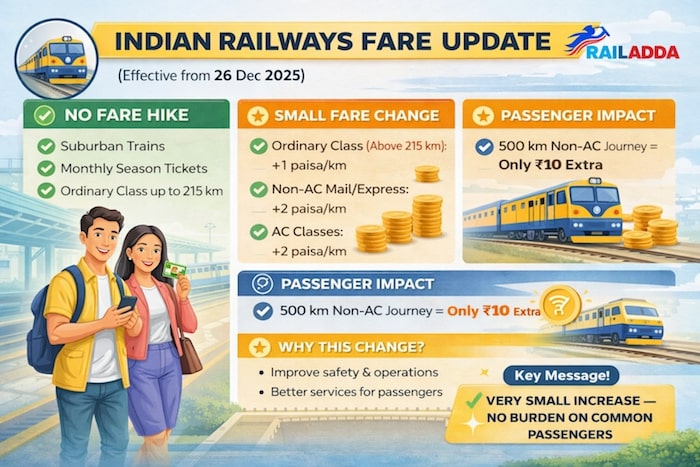
- No fare hike for suburban trains and monthly season tickets
- No increase for Ordinary Class journeys up to 215 km
- Marginal increase for long-distance and premium classes
- Railways to earn ₹600 crore annually from this rationalisation
Distance-Wise Fare Changes Explained
1️⃣ Ordinary Class Fare Changes
- Up to 215 km → ❌ No increase
- Beyond 215 km → ✅ 1 paisa per km increase
📌 Example:
A passenger traveling 300 km in Ordinary Class will pay only ₹0.85 extra.
2️⃣ Mail / Express (Non-AC) Fare Hike
- Increase of 2 paisa per km
📌 Example:
For a 500 km journey, passengers will pay ₹10 extra only.
3️⃣ AC Class Fare Revision
- AC fares increased by 2 paisa per km
This revision impacts long-distance AC travelers but remains one of the lowest incremental hikes in the last decade.
No Fare Hike for These Passengers 🚆
Good news for daily commuters and short-distance travelers:
- ✅ Suburban train passengers
- ✅ Monthly Season Ticket holders
- ✅ Ordinary Class travelers up to 215 km
This ensures affordability for students, office-goers, and economically weaker sections.
Why Indian Railways Increased Fares in 2025
Indian Railways has significantly expanded its operations over the past decade. With expansion comes increased expenditure.
Rising Costs Breakdown
- Manpower cost: ₹1,15,000 crore
- Pension cost: ₹60,000 crore
- Total operational cost (2024–25): ₹2,63,000 crore
To manage these costs without burdening passengers heavily, Railways opted for partial fare rationalisation instead of a steep hike.
Improved Safety & Operational Efficiency
Thanks to increased investment and better manpower deployment:
- India is now the second-largest cargo-carrying railway network globally
- Over 12,000 trains were successfully operated during the festive season
- Safety standards have significantly improved
The Indian Railway Fare hike directly supports these improvements.
Passenger Impact: Is the Fare Hike Significant?
👉 Short answer: No
For most passengers:
- The increase is negligible
- Long-distance travellers pay only a few rupees extra
- Daily commuters are completely unaffected
This makes the fare hike passenger-friendly and economically justified.
👉 Read more: Regional Cuisines on Vande Bharat Trains
FAQs on Indian Railway Fare Hike
❓ When will the Indian Railway Fare hike be implemented?
The revised fares will be effective from 26 December 2025.
❓ Is there any fare hike for suburban trains?
No, suburban and monthly season ticket fares remain unchanged.
❓ How much extra will I pay for a 500 km journey?
- Non-AC Mail/Express: ₹10 extra
- Ordinary Class (beyond 215 km): ₹5 approx
❓ Why did Indian Railways increase fares?
To manage rising manpower, pension, and operational costs, while continuing safety and infrastructure upgrades.
❓ Is this the biggest Indian Railway Fare hike?
No. This is one of the smallest and most passenger-friendly fare revisions in recent years.
Conclusion
The Indian Railway Fare hike 2025 focuses on sustainability rather than burdening passengers. With no increase for short distances and commuters, and only marginal hikes for long journeys, Indian Railways has struck a careful balance between public service and financial responsibility.
What is your opinion on the Indian Railway fare hike? Could rising operational costs have been managed through higher freight revenue instead? Share your views in the comments below.