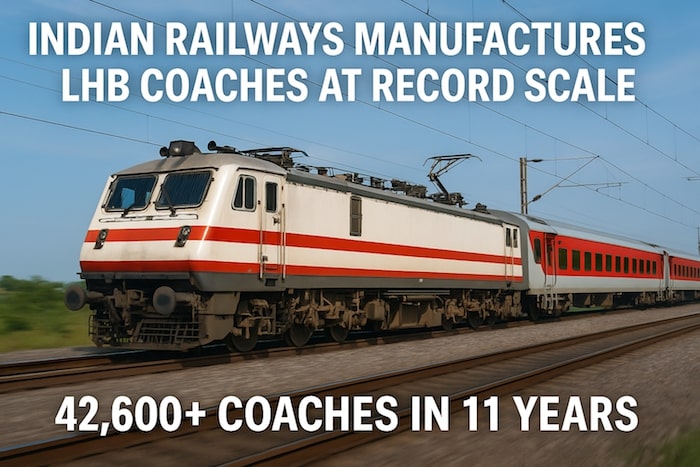
Indian Railways has achieved a historic milestone in railway modernisation by manufacturing over 42,600 LHB coaches in the last 11 years, marking a transformational shift toward safer, faster, and more comfortable rail travel. This massive production push highlights India’s commitment to Atmanirbhar Bharat and Make in India, while strengthening indigenous railway manufacturing.
Table of contents
- 1 What Are LHB Coaches in Indian Railways?
- 2 Record LHB Coach Manufacturing in FY 2025–26
- 3 18-Fold Increase in LHB Coach Production Since 2014
- 4 How LHB Coaches Improve Safety and Passenger Comfort
- 5 Boost to Atmanirbhar Bharat & Make in India
- 6 Future Plans for LHB Coach Manufacturing
- 7 Frequently Asked Questions (FAQs)
What Are LHB Coaches in Indian Railways?
LHB (Linke Hofmann Busch) coaches are modern passenger coaches originally designed in Germany and now fully manufactured in India. Compared to old ICF coaches, LHB coaches offer:
- Enhanced passenger safety
- Superior riding comfort
- Higher speed capability
- Lower maintenance cost
- Improved energy efficiency
These features make LHB coaches the backbone of Indian Railways’ passenger train modernisation.
Record LHB Coach Manufacturing in FY 2025–26
During the financial year 2025–26 (up to November 2025), Indian Railways manufactured more than 4,224 LHB coaches, registering an 18% year-on-year growth compared to the same period last year.
Factory-wise LHB Coach Production (FY 2025–26*)
| Railway Factory | LHB Coaches Produced |
|---|---|
| ICF, Chennai | 1,659 |
| MCF, Raebareli | 1,234 |
| RCF, Kapurthala | 1,331 |
| Total | 4,224+ |
*Up to November 2025
This growth reflects improved production planning, enhanced capacity, and better coordination across railway manufacturing units.
18-Fold Increase in LHB Coach Production Since 2014
A long-term comparison clearly shows the scale of transformation:
- 2004–2014: Only 2,300 LHB coaches
- 2014–2025: Over 42,600 LHB coaches
This represents an 18-fold increase, underlining Indian Railways’ sustained focus on replacing outdated ICF coaches with safer LHB designs.
How LHB Coaches Improve Safety and Passenger Comfort
LHB coaches are designed with anti-climbing features, preventing coaches from telescoping during accidents. Other benefits include:
- Crashworthy structure
- Advanced suspension system
- Reduced noise and vibration
- Better braking efficiency
- Higher operational speeds (up to 160 km/h)
These improvements ensure a smoother and safer travel experience for millions of passengers every day.
Boost to Atmanirbhar Bharat & Make in India
Indian Railways’ LHB coach manufacturing drive strongly supports:
- Atmanirbhar Bharat by reducing import dependence
- Make in India through indigenous design, production, and innovation
- Employment generation across railway manufacturing hubs
Factories like ICF Chennai, MCF Raebareli, and RCF Kapurthala now serve as global-scale rolling stock manufacturing centres.
Future Plans for LHB Coach Manufacturing
Indian Railways plans to further:
- Increase annual LHB production capacity
- Introduce next-generation LHB variants
- Upgrade existing trains to LHB rakes
- Meet rising passenger mobility demand
This aligns with India’s long-term vision of modern, safe, and high-capacity rail infrastructure.
Frequently Asked Questions (FAQs)
1. What does LHB stand for in Indian Railways?
LHB stands for Linke Hofmann Busch, a modern coach design originally developed in Germany and now manufactured in India.
2. How many LHB coaches has Indian Railways manufactured?
Indian Railways has manufactured over 42,600 LHB coaches between 2014 and 2025.
3. Which factories manufacture LHB coaches in India?
LHB coaches are manufactured at:
- Integral Coach Factory (ICF), Chennai
- Modern Coach Factory (MCF), Raebareli
- Rail Coach Factory (RCF), Kapurthala
4. Why are LHB coaches safer than ICF coaches?
LHB coaches have anti-climbing technology, stronger crash-resistant design, and advanced braking systems, making them significantly safer.
5. How does LHB coach manufacturing support Make in India?
It boosts domestic production, reduces imports, creates jobs, and strengthens India’s self-reliance in railway manufacturing.
Conclusion
With 42,600+ LHB coaches built in just 11 years, Indian Railways has firmly shifted into fast-track modernisation mode. Safer designs, smoother rides, and strong indigenous manufacturing show that the railways are not just upgrading trains—but redefining passenger travel. Backed by Make in India and Atmanirbhar Bharat, the journey toward a modern, world-class railway network is well and truly on track. 🚆